
-
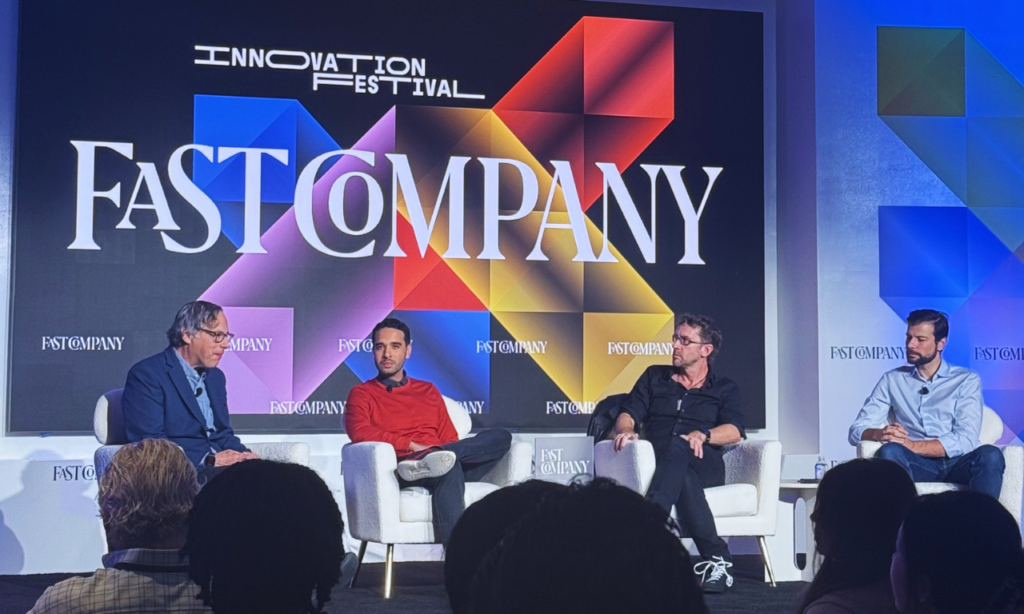
Harry McCracken, Global Technology Editor of Fast Company, moderates a panel on the future of artificial general intelligence (AGI) with Ziyaad Bhorat, Senior Advisor, Mozilla Foundation; Pablos Holman, General Partner, Deep Future; and Eiso Kant, Cofounder & CTO, Poolside, during the Fast Company Innovation Festival mainstage session on technology’s next frontier.
The 11th Annual Fast Company Innovation Festival brought together leaders from across technology, healthcare, manufacturing, finance, media, consumer brands and more. Hosted in New York City’s state-of-the-art Convene at Brookfield Place, the theme was clear: innovation is beyond chasing “what’s new” for its own sake, it’s about bringing resilience, responsibility, and long-term solutions into everything businesses build.
At Seneca Resources, we had the privilege of participating and listening firsthand. Here are five Festival takeaways that matter most for organizations navigating growth, transformation, and the future of work.
1) AI Moves from “Co-pilot” to “Autopilot”—and AGI on the Horizon
Artificial intelligence dominated the Festival—and the conversation stretched well beyond today’s chatbots. Enterprises are piloting agentic AI, or “AI agents,” that don’t just provide answers but take multi-step actions across systems.
Think of a tool that not only drafts an email campaign but schedules it, runs A/B tests, and optimizes delivery in real time. That shift—from assisting to acting—marks a pivotal change in how work gets done. During mainstage session “Will AGI Be a Reality—and Are We Ready?” top AI experts dove into the business and human ramifications of the AI evolution.
“We’re creating tools that give us an incredible amount of leverage, said Eliso Kant, Poolside AI, Cofounder and Chief Technology Officer, “Now an individual is no longer bottlenecked to bring 100 people into a business to start up, they can start today. We will have more businesses, more work, more competition than ever before.”
Even more ambitious, panelists discussed the long-term horizon of Artificial General Intelligence (AGI): systems with human-level reasoning that can flexibly apply knowledge across any domain. While timelines are debated, the implications are massive including new productivity models, new risks, and new governance challenges.
“These tools are enabling new systems of thinking, new organizations, new worlds and world-building, but that’s in our hands to define,” said Ziyaad Bhorat, Mozilla Foundation, Senior Advisor, “I’m excited about AGI but more excited about human potential to shape society, the systems, and organizations that we have taken for granted.”
Investing in agentic AI systems translates to thriving in today’s dynamic market with fewer resource constraints.
2) Healthcare: AI + 3D Printing Pragmatic Answers to Workforce Challenges
Healthcare is under unprecedented strain. Globally, the system faces a shortage of 10–15 million healthcare workers by 2030, including more than 1 million doctors in the U.S. alone. This has widespread implications for healthcare treatment, medical costs and patient care.
As such, in medical care, innovation is a necessity, not a luxury. According to Forbes, AI-assisted diagnostics are already improving cancer and rare disease detection as well as surgical assistance. This includes some direct support during surgical operations, reducing errors, increasing precision and efficiency.
“We’ve found that artificial intelligence presents an incredible opportunity to address the talent pool shortage in healthcare,” said Dominic King, M.D., Microsoft AI, VP of Health, “With the rapid advancement of AI, it’s becoming much easier to deploy AI while searching for the medical talent needed to close the growing gap.”
Another game-changing innovation in the medical field to be optimistic about is 3D printing. 3D printing in medicine is advancing on two major fronts:
- Personalized pharmaceuticals – Medicines can be rapidly manufactured and tailored for individual patients (children, adults, elderly), including adjustments for dose, release profile, or combination therapy. Most customization today is based on patient phenotype, prescription, or physical needs.
- Bio-printed tissues and organs – Living cellular materials can be printed for research models, grafts, and some functional tissues, offering an in-progress alternative to patients waiting years on donor lists. Use cases today are mostly for tissue patches, organoids, skin, joint cartilage, and medical devices rather than full organ replacement.
At the forefront of 3D printing in medicine is panelist Mansoor Khan, M.D., Dean of the Texas A&M College of Pharmacy.
“With 3D printing, we’re seeing a faster rate of delivery to patients, better accuracy with converting adult medicine for pediatrics, and increased access through cost-efficiency.” said Mansoor Khan, “We’re only scratching the surface but there’s tremendous potential for widespread improvement in our medical systems.”
This reinforces the importance of technology-enabled personalization and scalability, mirroring broader industry trends where businesses demand rapid, tailored solutions that improve outcomes while optimizing costs.
3) Digital Defense: Resilience, Rights, and Robust Security in a Connected World
At the Festival, digital resilience and cybersecurity emerged as top priorities amid escalating cyber threats, growing surveillance, and ongoing debates over net neutrality and federal policy. In the mainstage session, “Digital Defense: The Battle for an Open and Secure Internet,” experts from Mozilla, Cloudflare, the ACLU, and Firefox explored what’s truly at stake as the foundational principles of an open, trusted internet are put to the test.
Panelists noted that innovation is not limited to product development—it’s also about safeguarding digital rights, building transparent systems, and ensuring security at scale. As adversarial threats and intrusive technologies evolve, organizations must balance agility, openness, and privacy, while federal laws often lag behind.
“We’re seeing new attack surfaces and unprecedented levels of surveillance. The burden is on technology leaders and policymakers to design for resilience and defend an internet that remains open for innovation, free expression, and global collaboration,” said Daniel Kahn Gillmor, ACLU, Senior Staff Technologist.
Key takeaways included the necessity for transparent architecture, continuous threat monitoring, and accountability from both public and private sectors. Importantly, fostering an open and secure internet does not just protect business continuity—it protects the fundamental freedoms that underpin society’s capacity for innovation.
This takeaway reflects the session’s emphasis on security, freedom, and long-term responsibility in digital innovation, connecting to resilience and purposeful action—consistent with the overall themes of the Festival.
4) Fairtrade and Food Supply Chain Innovation
One of the most striking conversations focused on fair trade in food production. Today, nearly 1.9 million farmers and workers participate in Fairtrade-certified supply chains. Fairtrade is a certification system that ensures products are made fairly, helping farmers and workers in developing countries build mutually beneficial business relationships, obtain livable wages, and improve social and environmental standards.
According to the Social Justice Resource Center, Fairtrade certified products sell over $10 billion annually. However, this is still only about .02% of the world’s total consumer spending.
Despite the small footprint, innovation in supply chain transparency, certification, and reinvestment models makes a tangible impact on food quality and quality of life. This includes increased access to livable wages, food quality, shelter, education, and healthcare. Governments are stepping up—for example, the USDA has committed $270 million to supply chain resiliency grants. This provides financial incentives for companies that adopt fair trade practices and offers certification programs to ensure compliance with fair trade standards.
“As consumers, our buying decisions can have life-changing impact for food producers and workers at the beginning of the supply chain,” said Paul Rice, Fair Trade USA, Founder, “The real innovation is in people and how we ensure our everyday decisions shape a better world.”
Businesses focused on supply chains should prioritize innovations that enhance traceability, certification, and fairtrade practices—key differentiators for building loyalty and navigating regulatory incentives addressing social responsibility and sustainability.
5) Legacy Brands: Balancing Heritage with Disruption
Iconic names like PepsiCo and L.L.Bean are proving that innovation doesn’t mean abandoning legacy—it means building upon it. At the Festival, leaders shared how data-driven decision science, disciplined product testing, and cross-functional collaboration are guiding transformation, not just chasing every trend.
Lauren Prescott, SVP, Beverage Portfolio Marketing at PepsiCo, underscored this approach.
“Winning isn’t about reacting to every headline—it’s about having the discipline to choose what matters, test it relentlessly, and scale what rings true for our heritage and our customers.”
Strategic legacy evolution sustains loyalty. Trusted brands succeed when they update their story and experiences for today’s market, strengthening customer bonds through meaningful improvements, not constant overhauls.
It’s also important to collect and interrogate data. Data-driven decisions drive enduring results. Using decision science, rigorous testing, and clear criteria ensures that innovation delivers measurable, reliable growth and never alienates core audiences.
This approach empowers modernization, connects with new generations, and promotes sustainable growth—building on the strengths that make them brands iconic while adapting to meet tomorrow’s needs.
Why Innovation Matters
Fast Company Innovation Festival 2025 made one thing clear: innovation is not a one-off project or a fleeting trend—it’s a disciplined approach to building resilient, enduring organizations. Whether embedding responsible AI, navigating the cyberthreat landscape, reimagining supply chains, transforming healthcare, or balancing brand heritage, the common thread is clear: progress happens when creativity meets accountability. Bold ideas are tempered by purposeful execution, and speed is paired with diligence.
At Seneca Resources, our commitment is to help organizations build the muscle for lasting innovation—not just chasing what’s next, but creating impact that endures. We empower clients to turn breakthrough thinking into real, sustainable results—fueling growth, strengthening culture, and shaping the future, quarter after quarter and year after year.
For more about workforce and consulting solutions that support your innovation goals, please contact us at info@senecahq.com or 703-390-9099.