
By Dustin Molter
The rapid expansion of data centers is often discussed as a technology or real estate story. Companies are investing billions of dollars in land, buildings, servers and fiber infrastructure to support cloud computing and artificial intelligence.
But every data center is also a major energy project.
As facilities grow larger and more computationally intensive, their demand for electricity is reshaping utility forecasts, interconnection processes, and grid-modernization priorities. In the regions attracting the most development, utilities must determine how to connect loads of unprecedented scale without compromising reliability or shifting unreasonable costs to existing residential and commercial customers.
The data center boom is no longer adjacent to utility planning but is becoming one of its defining challenges.
Electricity Demand Has Changed Direction
For much of the period between 2005 and 2019, U.S. electricity demand remained relatively flat. That trend has changed.
The U.S. Energy Information Administration reports that electricity demand grew at an average annual rate of approximately 1.7% between 2020 and 2025, compared with just 0.1% between 2005 and 2019. EIA identifies data centers as a primary driver of the increase. (U.S. Energy Information Administration)
Lawrence Berkeley National Laboratory estimates that data centers consumed approximately 176 terawatt-hours of electricity in 2023, or 4.4% of total U.S. electricity use. Its subsequent update projects that data centers could account for 11.8% of U.S. electricity consumption by 2030, with likely scenarios ranging from 9.5% to 15.3%. (Lawrence Berkeley National Laboratory)
Those national figures do not capture the full regional effect. Data center development is concentrated in markets such as Virginia and Texas, where individual utilities and grid operators face especially large increases in demand.
In Virginia, commercial electricity sales grew by nearly 30 million megawatt-hours between 2019 and 2025, driven largely by the concentration of data centers along with electric vehicles and building electrification. (EIA)
Texas illustrates the scale of proposed growth. As of March 2026, ERCOT was tracking approximately 410 gigawatts of large loads seeking interconnection, with data centers representing about 87% of the total. An interconnection request is not the same as a completed project, and many proposed loads will not ultimately be built. Even so, the volume demonstrates the uncertainty grid planners must manage. (ERCOT)
The Challenge Is More Than Generating Enough Power
It is tempting to reduce the issue to a single question: Can the region generate enough electricity? While generation is essential, it is only one part of the challenge.
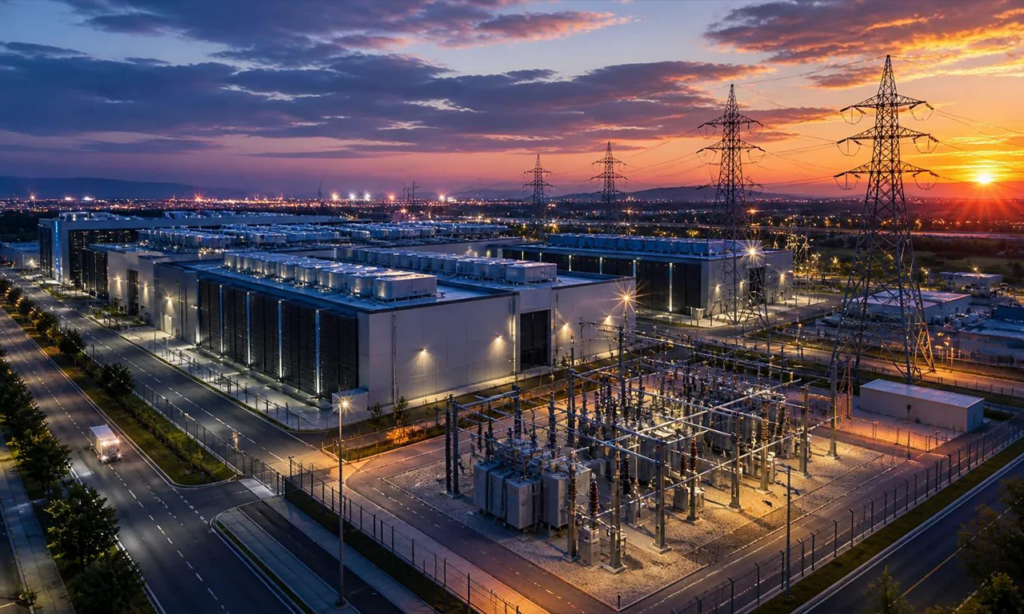
Power must be transmitted from where it is produced and distributed to the location where it will be consumed. Large data centers may require new substations, transmission lines, distribution upgrades, transformers, and control systems. These projects can take years to plan, approve, and construct.
Utilities must also consider:
- Whether the requested capacity reflects a committed project or an early-stage proposal.
- When the load will actually come online.
- How quickly demand will ramp.
- Whether the facility can reduce load during periods of grid stress.
- Who will pay for the infrastructure required to serve it.
- How new equipment will affect reliability.
- Whether generation and transmission can be completed on compatible timelines.
- What other industrial, commercial and residential growth must be supported.
The uncertainty is significant. Data center developers may seek as much capacity as they believe the facility could eventually require, even when the final demand is not yet known. Utilities must avoid underbuilding for real growth while also protecting customers from investments made for projects that never materialize.
Interconnection Must Become More Coordinated
Traditional large-load interconnection processes were not designed for the current volume, speed, and concentration of data center proposals.
Grid operators are adapting. ERCOT, for example, is developing a batch-study process intended to improve the consistency, transparency, and efficiency of evaluating large-load requests while maintaining a system-wide view of reliability. (ERCOT Large Load Integration)
This broader view matters because individual projects cannot be evaluated in isolation. Several data centers proposed within the same region may depend on overlapping transmission, generation, and equipment resources. Studying each request independently can create an incomplete picture of the cumulative effect.
Utilities, grid operators, developers and regulators need better coordination around:
- Proof that a project is commercially viable.
- Realistic timelines and demand forecasts.
- Infrastructure responsibilities.
- Cost allocation.
- Flexible-load capabilities.
- Generation and transmission dependencies.
- Data sharing as project plans change.
The objective here is not to prevent data center development. Rather, it is to distinguish viable projects from speculative requests and connect new facilities without weakening service for existing customers.
Grid Modernization Becomes More Urgent
Data center demand arrives as utilities are already managing other major changes.
Electric-vehicle adoption, renewable integration, distributed energy resources, aging infrastructure, extreme weather, and cybersecurity all require investment. In many markets, data centers amplify the need for modernization rather than replacing those existing priorities.
Utilities may need improved forecasting and grid modeling to understand future demand. They may require greater visibility into real-time conditions, more automated control, stronger operational communications and additional cybersecurity protections.
Advanced metering, sensors, data platforms, and automated systems can help utilities monitor and manage a more complex grid. But technology alone will not solve the challenge. Utilities also need the engineering, construction and technology talent required to design and implement the supporting infrastructure.
That workforce may include:
- Transmission and distribution engineers.
- Substation and protection engineers.
- Fiber-optic and network professionals.
- Construction managers.
- Program and project managers.
- Grid-modeling and data specialists.
- Cybersecurity professionals.
- Operational technology experts.
Competition for these skilled professionals is likely to grow alongside the projects themselves.
Utilities Need an Enterprise-Level Response
The organizations most prepared for data center growth will not treat it as a series of isolated service requests. They will connect large-load planning to their broader grid strategy. That means understanding the totality of how data center development affects generation, transmission, distribution, technology, cybersecurity, capital planning, and workforce capacity.
A coordinated response needs to include:
- More rigorous demand validation. Utilities need credible information about project timing, size and probability.
- Scenario-based planning. Forecasts should account for different levels and speeds of data center development.
- Integrated infrastructure planning. Generation, transmission, distribution and communications should be evaluated together.
- Clear cost-allocation principles. Existing customers should not automatically bear the risk of speculative projects.
- Flexible-load strategies. Where operationally feasible, data centers may help reduce stress by adjusting demand during critical periods.
- Workforce planning. Utilities and their partners need pipelines for the engineering, construction and technology expertise required.
- Cybersecurity by design. New digital and operational connections should be secured as they are built.
These decisions require collaboration across utility functions that have historically operated separately. De-siloing is a challenging but necessary effort requiring advanced strategic and tactical planning.
A New Era for Utility Planning
The growth of data centers is creating real economic and technological opportunity. The infrastructure being built will support AI, cloud services, and an increasingly digital economy.
But those benefits depend on an electrical system capable of supporting them. Utilities must prepare for demand that is larger, more concentrated, and less predictable than the small-but-steady growth many have managed in recent decades. They must make long-term infrastructure decisions while project plans and computing technologies continue to change.
That will require better data, stronger planning, modern grid technology and access to specialized talent. It will also require closer coordination among utilities, developers, regulators and infrastructure partners.
The next chapter in the on-going data center story will be written by the organizations responsible for building and operating the grid upon which it depends.